One in five kids are already overweight. The fix has been sitting in a drawer since 2017.
Sugar is taxed. Junk food ads aimed at children aren't. A food safety law that could change a lot of this was written years ago. Nobody has signed it.
25 June 2026
0
One in Five Maldivian Kids Are Overweight. The Law That Could Fix It Is Still Unsigned.
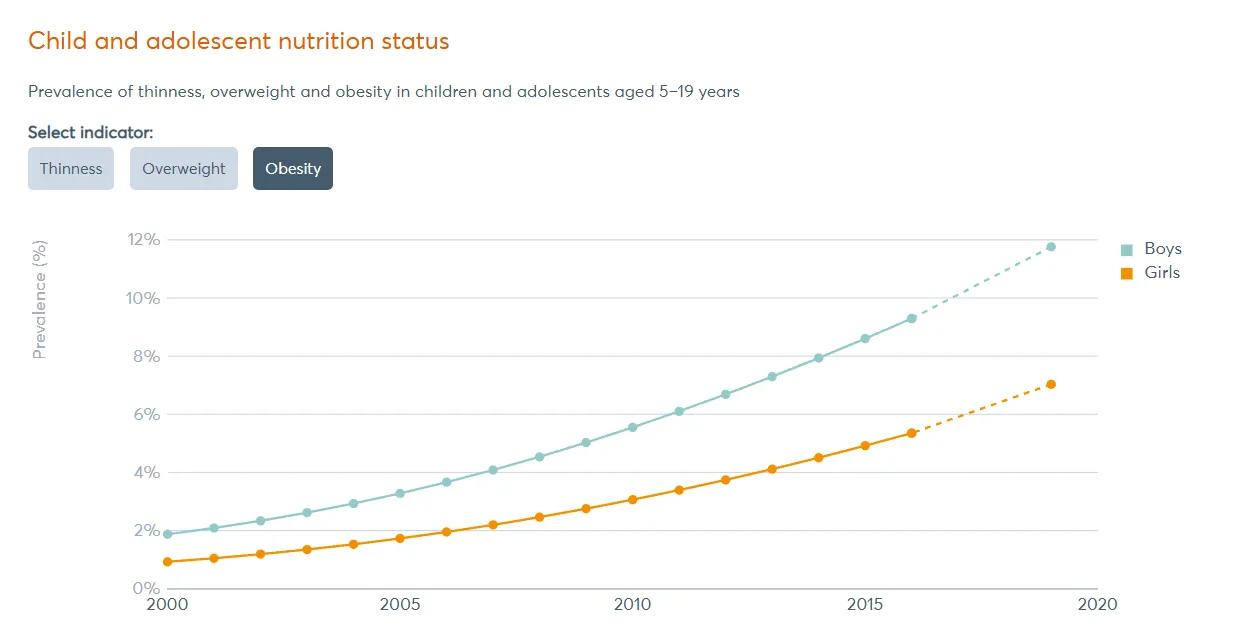
• 1 in 5 children in the Maldives are overweight or obese, with obesity alone affecting 13%, and climbing roughly 7% a year.
• A food safety regulation drafted in 2017, covering imports, labelling, and inspection, has never been signed into law.
• Five government bodies share food-safety duties, and none of them owns the problem outright.
• A 2020 sugar tax only applies to imports: 75% of soft drinks sold in the Maldives are bottled locally and untaxed.
• The Maldives has no ad ban on junk food aimed at kids and no warning label requirement, unlike the UK, Chile, Norway, Sweden, Mexico, and South Korea.
• The fix: sign the regulation, tax sugar directly, require warning labels, ban ads aimed at kids, and give one agency clear enforcement power.
One in five school-aged kids in the Maldives are overweight or obese right now. Thirteen percent are obese outright. And the number keeps climbing, about 7% more every year.
Here’s the strange part: there’s already a fix sitting around. A regulation was drafted back in 2017 that could help slow all this down. Nobody has signed it.
This isn’t a story about a problem nobody saw coming. The people in charge have known about it for years. They even wrote down a solution. They just never used it.
Five government bodies share the job of keeping food safe in this country, and somehow none of them owns the problem outright. The kids actually paying the price are mostly teenage girls in Malé. Since that 2017 policy first pointed out the gaps, the only real move anyone’s made was a 2020 tax hike, and even that missed most of what it was supposed to catch. Underneath all of it is one basic fact: this is a country that imports 95% of its food, so the fight happens both at the border and on the store shelf, and right now those two places aren’t talking to each other. Here’s how that happened.
The Numbers
This doesn’t hit every kid the same way. It’s worse between ages 13 and 17, the years when habits set for life. Kids in Malé have it worse than kids on the outer islands. And girls have it worse than boys, partly because teenage girls tend to get less daily exercise.
What the adult data already shows
Nobody has run a long-term study tracking Maldivian kids into adulthood to see how many stay overweight. But there's a clue sitting right there: 82.6% of Maldivian women between 35 and 49 are overweight or obese. You don't need a 20-year study to see where this is heading.
Already Getting Sick
This isn’t something that might happen down the road. It’s already showing up in clinics across the country:
· Type 2 diabetes seen (once an adult-only disease) in Maldivian teenagers.
· Blood pressure levels you would expect in someone twice their age, as extra weight makes the heart work harder and narrows blood vessels over time.
· Sleep apnea, where weight around the neck blocks the airway during sleep.
· A bullying → anxiety → emotional eating loop that makes the original weight problem worse
None of it just resolves on its own.
Five Agencies, No Owner
Ask who's in charge of food safety here and you'll get five different answers depending on who you ask.
Five agencies, one job
MFDA - Regulation
Health Ministry - Sets policy
Econ. Dev - Label checks only
Councils & HPA - Occasional inspection
Customs- Border checks only
"overlaps and gaps" — by the government's own admission
On the outer islands, local health care facilities handle inspections, while the Maldives Food and Drug Authority (MFDA) cover the Greater Malé area, though both only ever manage to check a handful of shops. Even the government’s own policy paper admits regular market inspections are basically missing, a serious gap in a country that imports 95% of its food..
Food safety remains a national priority, and addressing overlaps and gaps within the Maldives Food and Drug Authority (MFDA) will require strengthened governance, clear role delineation, and risk-based regulatory approaches. Key mechanisms include revising mandates and SOPs, enhancing coordination among divisions, implementing integrated inspection and information management systems, strengthening laboratory and surveillance capacities, and establishing performance monitoring frameworks. Regular stakeholder engagement, staff capacity building, and alignment with international food safety standards will further improve regulatory effectiveness and accountability.
Satheesh Moosa | Deputy Director General, MFDA
A Law Nobody Signed
Two basic pieces of food-safety infrastructure are still missing in the Maldives.
A regulation covering food imports (nutrition labels, inspections, and traceability), drafted years ago by the MFDA and still not law
A national standards agency, the law for which is also still being drafted
You can’t enforce a rule that was never made official, and right now the country has neither the rule nor the agency that would enforce it.
A Tax With a Hole In It
There has been one real step forward. In 2020, the government nearly doubled the import tax on energy drinks and soft drinks. On paper, that looked like solid progress.
Here’s the catch, though. About three-quarters of the soft drinks sold in the Maldives (Coca-Cola, Sprite, Fanta, Schweppes) are bottled locally, not imported. The tax only applies to what arrives by ship.
No Ad Ban. No Warning Label.
Other countries have already worked out what helps. The UK doesn’t allow junk food ads aimed at kids. Neither do Chile, Norway, Sweden, Mexico, or South Korea. Chile goes further and slaps big black warning labels on unhealthy packaging.
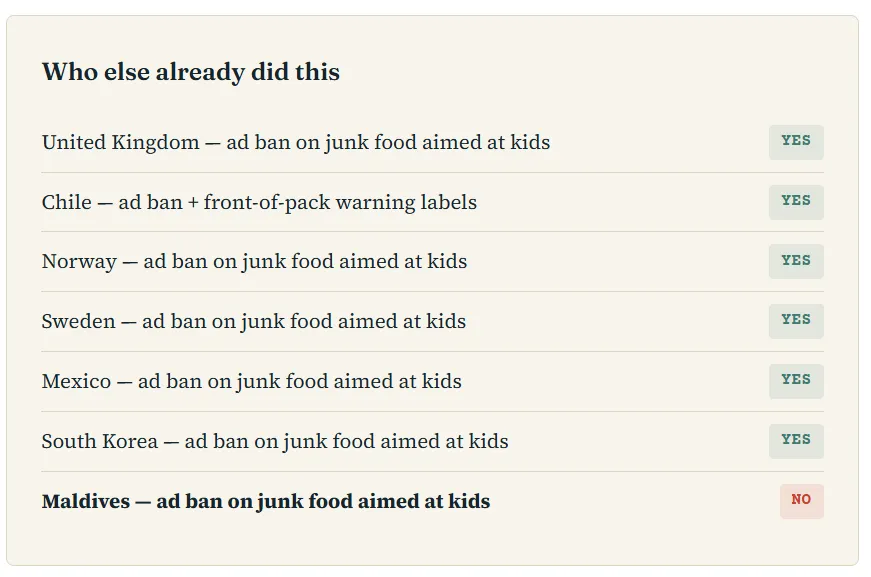
The country clearly knows how to crack down hard on something harmful. It just hasn’t chosen to do it for sugar.
The Bill Comes Due
· Childhood obesity already costs around $240 per child a year in medical bills.
· That figure is expected to climb to $4.32 trillion a year worldwide by 2035.
For the Maldives, that cost won’t spread out evenly. With a healthcare system stretched thin across small islands and dependent on moving patients between them, every year of delay just adds straight to the bill.
Why No One Stops It
This isn’t about anyone being unaware. The evidence is sitting right there in the government’s own reports. What exists instead is a system built for inaction:
Five agencies are splitting one job.
A law that’s stayed in draft for years.
A tax with a built-in gap.
Zero rules on how junk food gets marketed to kids.
None of these problems looks huge on its own. Put them together, and they add up to a system that just doesn’t move.
What Would Actually Work
Sign the food import regulation that's already written
Tax sugar itself, not just imported sugar
Put warning labels on the front of the package
Stop junk food ads aimed at kids
Give one agency the power to actually enforce all of it
None of this is new or untested. Chile and Norway have already proven it works. The Maldives doesn't need more proof. It needs to act on what it already knows.
The regulation that could change this story has been ready since 2017. Every year it stays in the drawer is another year the bill medical and otherwise keeps growing.
Author
Health Insight Maldives
Leave a comment
Comments
No comments yet. Be the first to comment!