Paradise Poisoned
While the world pictures the Maldives as pristine blue water and white sand, a quieter crisis is building above the surface in the air that 500,000 residents breathe every day.
25 June 2026
0
Paradise Poisoned
On most mornings, a thin brown haze sits over Malé like a second horizon. It is not mist the Indian Ocean provides no fog at sea level here. It is smoke: from the Thilafushi waste-burning facility to the west, from the endless diesel generators that power a nation with almost no grid electricity, and increasingly from the boats, ferries, and floatplanes that carry 1.8 million tourists a year through one of the world's least-studied air quality environments.
The Maldives' reputation is built on what visitors see below the waterline. But above it, the story is more complicated and for the people who actually live here, considerably more urgent.
What the numbers reveal
The Maldives Environment Protection Agency operates a small network of air quality monitors, concentrated almost entirely on Malé and Hulhumalé. What they record contradicts the country's clean-air image. Annual PM2.5 in Malé averages around 17 µg/m³ well above the WHO's 5 µg/m³ guideline and broadly comparable to mid-tier South Asian cities. During southwesterly monsoon months, when winds carry pollution from India and Sri Lanka, peak readings regularly exceed 35 µg/m³.
Malé monthly PM2.5 (µg/m³) vs WHO guideline - 2024 estimate
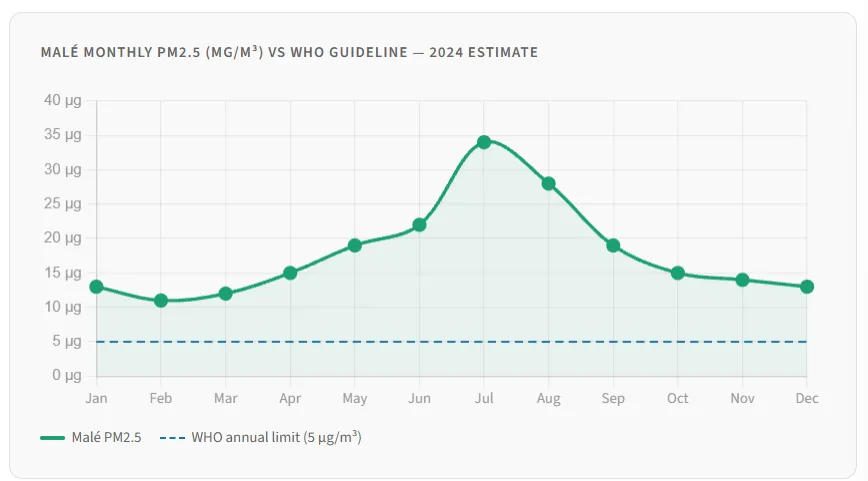
The monsoon spike is only partly explained by transboundary pollution. The other driver is domestic: waste burning peaks when heavy rain makes landfill management harder, and diesel generator usage rises when solar panels underperform in overcast conditions. The result is that the Maldives' worst air quality months align almost exactly with its wettest, when residents are most confined indoors.
We talk endlessly about rising sea levels. We talk very little about the air. But the air is affecting people right now, today in every clinic across these islands.
— Dr Fathimath Shareef, Indira Gandhi Memorial Hospital, Malé
Three fires, one small nation
Attribution studies in Small Island Developing States are rare, but emission inventory work by the UNEP and regional partners points to three dominant local sources, each deeply embedded in the Maldivian economy and each resistant to rapid policy change.
Estimated PM2.5 source contribution — Malé
Diesel gen. 34% Waste burning 28% Marine transport 21% Transboundary 12% Dust/other 5%
🔥Thilafushi waste island
330 tonnes of unsorted waste burned daily. Open burning produces black carbon, dioxins, and heavy metals at levels with no safe exposure threshold.
⚡Diesel dependency
The Maldives runs on 300+ diesel generators across 187 inhabited islands. Grid interconnection is almost nonexistent outside Greater Malé.
⚓Marine traffic
Over 1,200 speedboats and ferries operate between atolls on unregulated heavy fuel oil a significant and growing source of maritime PM2.5.
Who is most at risk
Vulnerability in a dispersed archipelago
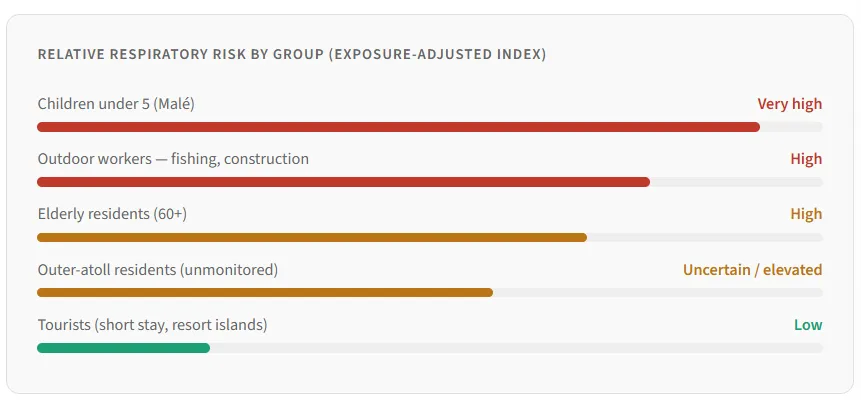
The Maldives' geography 187 inhabited islands across 90,000 square kilometres of ocean means that pollution is not evenly distributed, but neither is the capacity to escape it. Residents of the densely packed urban islands face the highest concentrations. Outer-atoll residents face a different problem: no monitoring, no hospitals with respiratory specialists, and no data at all on what they are breathing.
What chronic exposure does to the body
🫁 Respiratory illness
Asthma prevalence among Malé children under 12 is estimated at 18% double the global average. Chronic bronchitis rates are rising in all age groups.
❤️ Cardiovascular strain
Diesel black carbon is the most cardiotoxic fraction of PM2.5. The Maldives' heavy diesel dependency creates disproportionate cardiovascular risk relative to total PM2.5 exposure.
🤰Maternal and fetal
Elevated monsoon-season PM2.5 coincides with peak Maldivian birth registrations. No study has yet investigated preterm birth correlations — a critical research gap.
"The irony is almost too cruel. The same tourists who fly here to experience pristine nature are arriving in a country where children in the capital city cannot safely play outside on bad air days."
— Ibrahim Waheed, EPA Maldives, Indian Ocean Climate Forum 2024
A timeline of slow action
2008 - Environment Protection Act enacted
First legal framework for environmental standards. Air quality provisions remain vague, with no binding ambient limits set for a decade.
2016 -Thilafushi masterplan commissioned
Consultants recommend transitioning to waste-to-energy and halting open burning within five years. Open burning continues today.
2019 - National Ambient Air Quality Standards gazetted
Annual PM2.5 standard set at 25 µg/m³ five times the WHO guideline. Enforcement mechanisms remain unspecified.
2023 - Renewable energy target: 33% by 2025
Solar installations expanded across 60 islands. Progress is real but uneven outer atolls lag badly, and diesel remains the backbone of national energy supply.
2025 - Hulhumalé waste facility announced
A modern incineration plant with emission controls is planned for Hulhumalé Phase II. Construction timeline and funding sources remain unconfirmed at publication.
What the Maldives lacks is not ambition policy documents articulate a green transition with genuine clarity. What it lacks is enforcement infrastructure, monitoring coverage, and the political will to impose costs on industries that have operated unregulated for decades. Until Thilafushi's fires are brought under control and diesel generation is systematically replaced, the gap between the Maldives on a tourism poster and the Maldives in a health report will keep widening.
Author
Health Insight Maldives
Leave a comment
Comments
No comments yet. Be the first to comment!